Why complex B2B projects need more than a storefront
Many B2B e-commerce projects start with a familiar idea: “We already know Magento, Shopware, Oxid or Shopify. Let’s use that and add the B2B requirements on top.”
At first glance, this sounds efficient. The storefront is familiar, the ecosystem is strong and teams can launch quickly. And in many cases, this approach works.
About our Guest:
Martin Rommel is Managing Director of ECOPLAN E-Commerce GmbH, on a mission to make digital commerce work better for B2B businesses. Based in Künzell near Fulda, Germany, he has been helping manufacturers, industrial companies and wholesalers digitalize their sales and service processes since the late 1990s.
Drawing on decades of experience from numerous e-commerce projects, he continues to shape the development and market positioning of the B2B e-commerce platform avanta. Because when digital commerce fits the way businesses work, growth follows naturally.

Once B2B e-commerce becomes more than a digital ordering channel, the architectural question changes. It is no longer just about the shop, the frontend or the checkout. It becomes a question of where the business logic lives.
That is where the difference between a B2C system extended for B2B and a native B2B e-commerce platform becomes critical.
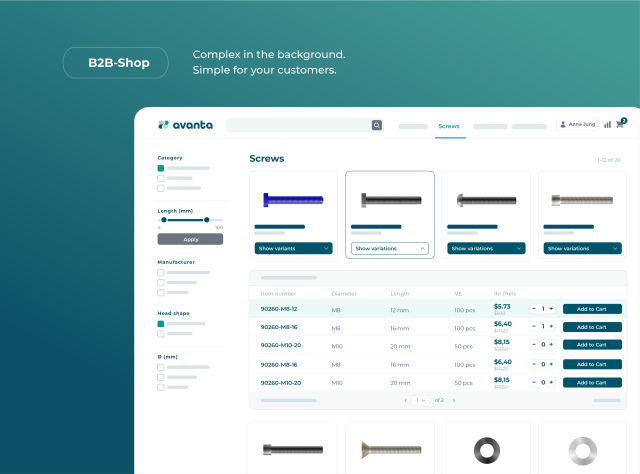
avanta is an ERP-first B2B e-commerce platform designed to digitize sales, service and after-sales processes directly from the ERP.
B2B is not an add-on
B2C commerce is usually built around a customer-facing shopping experience: product discovery, cart, checkout, payment and fulfilment.
B2B e-commerce is different. In B2B, the online channel often needs to reflect:
- customer-specific prices and conditions
- contract-based assortments
- approval workflows
- ERP-based availability
- procurement integration
- spare parts logic
- service and after-sales processes
In other words, the shop is often not the centre of the architecture. The process is. And in many B2B organizations, that process is defined by the ERP.
That is why the core question in complex B2B e-commerce is not simply: “Can the shop system do this?”
The better question is: “Where should this logic live?”
Retrofitted B2C architecture: fast to start, harder to scale
A B2C-first system extended for B2B often follows the same pattern:
- the shop becomes the main project layer
- B2B requirements are added through extensions or custom code
- pricing and customer logic are rebuilt or synchronized into the shop
- ERP integration is connected, but not always truly leading
- special cases are solved individually over time
This can be a valid approach for companies with relatively simple B2B requirements.
But once complexity grows, the architecture often becomes harder to maintain. Pricing logic may exist in several places. Product structures become difficult to govern. Integrations become more fragile. Custom code increases.
The result is familiar: B2C plus add-ons can be fast to launch, but complex to scale.
Native B2B commerce starts from process, not storefront
A native B2B platform starts from a different assumption.
Instead of asking: “What can we add to the shop?” It asks: “How can we digitally reflect the company’s existing B2B processes?”
This means:
- B2B logic is part of the platform’s standard functionality
- the ERP remains the leading system
- customer-specific rules are expected, not exceptional
- the e-commerce platform becomes a digital process layer, not a duplicate logic layer
This is the idea behind an ERP-first B2B e-commerce architecture.
With avanta, relevant sales processes and data remain in the ERP and are used by the commerce platform instead of being recreated in the shop. The goal is to reduce duplicate maintenance, avoid unnecessary custom development and keep business processes consistent as requirements grow.
Use case 1: ERP-first pricing and customer-specific conditions
One of the most common B2B requirements is customer-specific pricing.
In a B2C-first setup, pricing logic is often replicated in the commerce layer or synchronised from the ERP into the shop. That may work for simple pricing models.
But many B2B companies deal with:
- individual customer prices
- contract prices
- discount logic
- tier prices
- customer-specific product availability
- market- or sales-unit-specific conditions
The more of this logic is duplicated in the shop, the greater the risk of inconsistency.
In an ERP-first setup, pricing remains where it belongs: in the operational source of truth. The commerce platform uses this logic instead of rebuilding it unnecessarily.
This is one of the most important structural differences between a retrofitted B2C architecture and a native B2B platform.
The goal is not just to display prices online.
The goal is to make sure customers see the same commercial logic online that already governs sales, service and order processing internally.
Use case 2: PunchOut and procurement integration
Another clear B2B differentiator is procurement connectivity. Large customers often do not want to order manually in a traditional webshop. They want to buy through their own procurement systems.
That means OCI or cXML PunchOut, structured order transfer and integration into existing purchasing workflows.
For a B2C-first architecture, this is usually not a native assumption. It often becomes an additional integration project. For a native B2B platform, procurement integration is part of the expected B2B reality.
avanta supports dedicated B2B modules such as OCI PunchOut and cXML PunchOut. This allows suppliers to connect directly to their customers’ procurement processes, reduce manual order effort and strengthen their position as a preferred supplier.
This is a good example of why B2B e-commerce should not be reduced to “a shop”. In many cases, B2B e-commerce is a digital connection between two companies’ business systems.
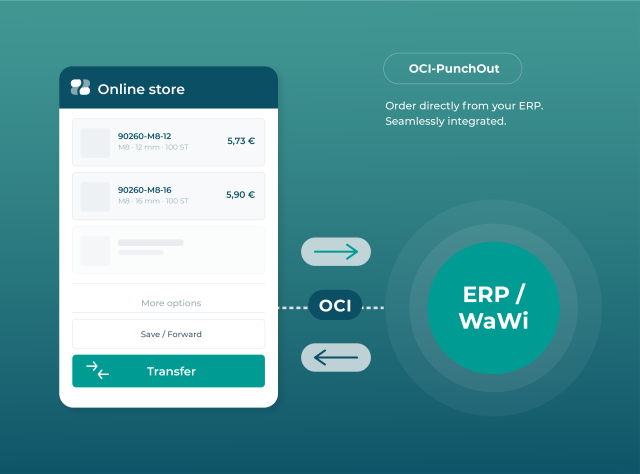
PunchOut is not merely a frontend feature. It connects supplier commerce processes directly with customer procurement systems.
Use case 3: Spare parts and after-sales
Spare parts business is one of the clearest examples of why native B2B architecture matters.
Here, customers do not simply browse a product catalog. They need to identify the correct part quickly and reliably, often based on machine structures, assemblies, usage context or technical drawings.
A typical spare parts process may involve:
- machines or systems in use
- installed components
- assemblies and parts lists
- customer-specific machines or locations
- maintenance history
- prices and availabilities from the ERP
- direct ordering of the correct spare part
If this logic is recreated manually in the shop, the process quickly becomes difficult to maintain.
In an ERP-first setup, the leading data already exists in the ERP: parts lists, structures, prices, availabilities and customer-specific information. The e-commerce platform can use this logic directly instead of duplicating it in the storefront.
avanta’s spare parts and after-sales use case shows how this can work in practice: customers and service teams can access machine- or system-specific information, identify parts through structured assemblies or clickable drawings and order the correct spare part directly.
The business impact is practical:
- fewer incorrect orders
- fewer service queries
- faster identification of parts
- less manual effort in service and back office
- more consistent processes from product identification to ERP order
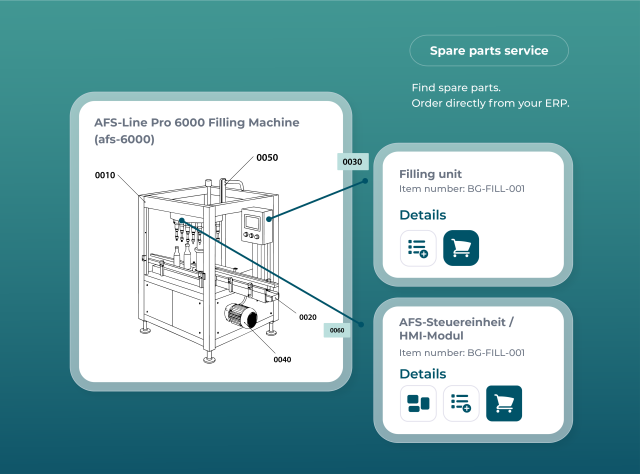
Interactive spare parts views help customers and service teams identify the right part faster - based on ERP-managed structures and logic.
Mini case: International rollout with complex product logic
Complexity is not only about individual processes. It is also about scale.
A strong example is Gühring, one of the world’s leading manufacturers of rotary precision tools. With avanta, Gühring launched a B2B webshop across 18 countries and 13 languages.
The project also illustrates a typical B2B challenge: presenting a complex product range with many variants in a way that helps customers find the right item.
Another highlight is automated reordering via tool dispensing cabinets. Once a tool is removed, the cabinet sends the relevant information to avanta. Based on stored rules, the online shop automatically orders the required replenishment.
That is not a standard webshop scenario. It is digital process integration.
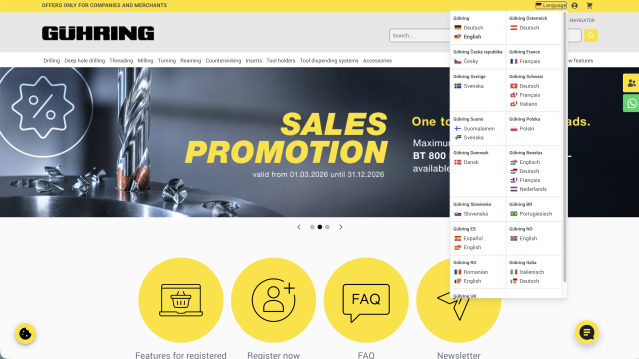
Internationalisation, complex variants and automated replenishment show how B2B commerce can extend far beyond standard storefront functionality.
Conclusion: B2B e-commerce is an architecture decision
A retrofitted B2C system can be a pragmatic way to get started. But in complex B2B projects, the challenge is rarely the storefront alone.
The real challenge is whether the architecture can support customer-specific logic, ERP-driven processes, procurement integration, spare parts scenarios and long-term scalability without creating duplicate logic and excessive custom development.
That is why native B2B e-commerce should not be seen as “more features”. It should be seen as a different architectural model.